Bitcoin and the Birth of Digital Scarcity
August 28, 2025
For most of history, money had one simple rule: if it exists, it can be spent once. A gold coin leaves your hand and enters someone else’s. A dollar bill can’t be duplicated.
But when computers came along, money hit a problem: digital files can be copied. If money became just another file, what would stop someone from spending the same digital coin twice?
This puzzle — known as the double-spending problem — blocked digital money for decades. Until Bitcoin.
---
Why Scarcity Matters
Scarcity is what makes money valuable.
- Gold is scarce in the earth. - Dollars are scarce because governments limit supply (at least in theory). - Baseball cards or NFTs are scarce because communities agree only a fixed number exist.
If something can be copied infinitely, it stops being money and becomes just data. Solving digital scarcity was the key to making internet-native money possible.
---
Early Attempts at Digital Cash
Before Bitcoin, brilliant minds tried to build digital money:
- David Chaum’s eCash (1990s): encrypted digital cash linked to banks. - Hashcash (1997): proof-of-work to fight spam, invented by Adam Back. - b-money (1998) by Wei Dai and Bit Gold (2005) by Nick Szabo: visionary proposals for decentralized money.
Each idea moved closer, but all had limitations: reliance on central authorities, inability to prevent double-spending without trust, or lack of adoption.
---
Enter Bitcoin (2009)
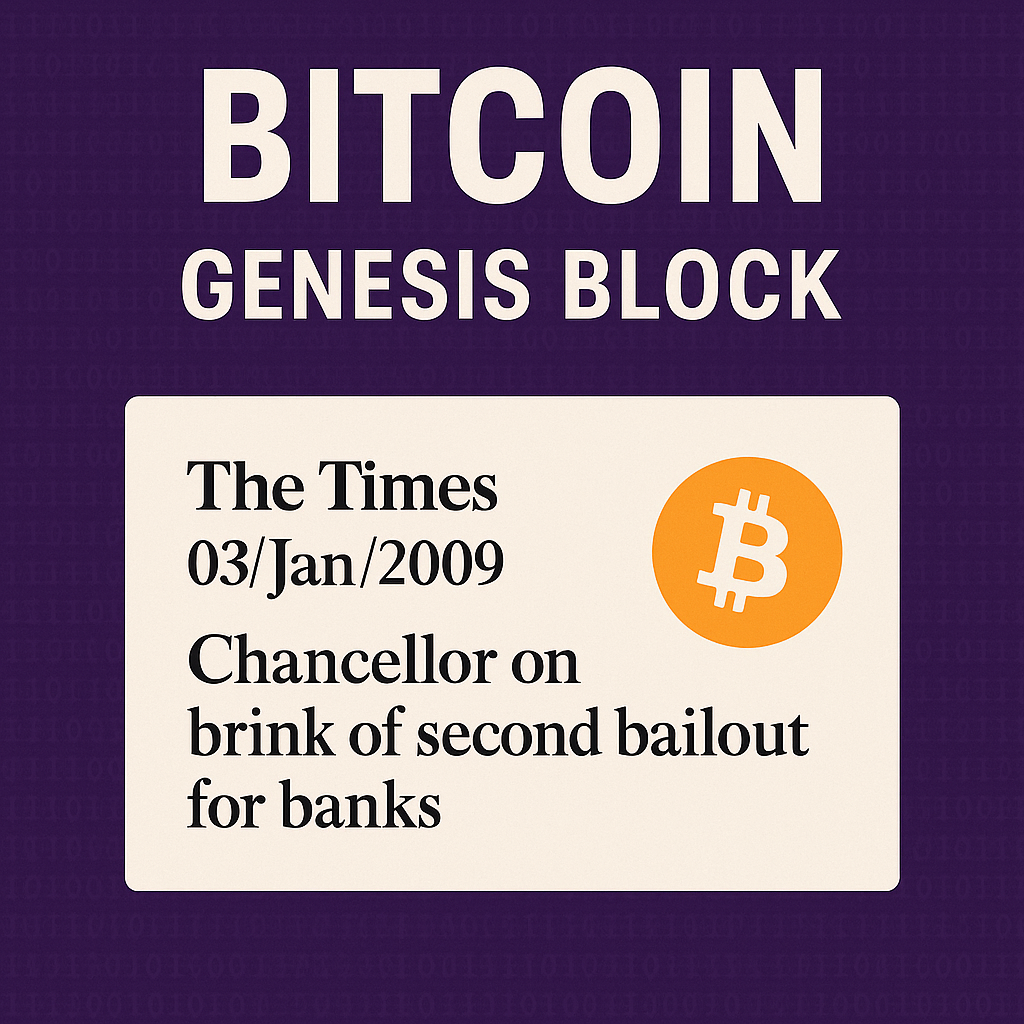
On January 3, 2009, an anonymous figure known as Satoshi Nakamoto launched Bitcoin with the Genesis Block.
Bitcoin’s design was radical because it combined three existing ideas in a new way:
1. Blockchain ledger → every transaction recorded publicly, preventing double spending. 2. Proof of Work → miners compete to add blocks, securing the system without a central bank. 3. 21 million fixed supply → scarcity baked into code, no politician or banker can print more.
For the first time, money on the internet could be: - Limited (like gold). - Portable (like email). - Trustless (you don’t need a middleman).
---
Digital Scarcity Explained
Think of Bitcoin as a public spreadsheet (the blockchain).
- Every time you send Bitcoin, the transaction is written to the sheet. - Everyone can see it, so you can’t spend the same coin twice. - The sheet is duplicated on thousands of computers worldwide. - No one person controls it, so no one can cheat.
Because supply is capped at 21 million, Bitcoin is the first scarce digital asset in history. That’s why people call it “digital gold.”
---
Why It Mattered
Bitcoin didn’t just create a new kind of money — it sparked an entire ecosystem:
- Store of Value: many see it as “gold 2.0,” a hedge against inflation. - Global Transfers: anyone can send value across borders without a bank. - Financial Freedom: in countries with unstable currencies, Bitcoin can be a lifeline.
Critics call it volatile, slow, or speculative. But no matter what, Bitcoin proved one thing: Digital scarcity is possible.
---
Beyond Bitcoin
After Bitcoin, other projects explored new frontiers:
- Ethereum (2015) added programmable money (smart contracts). - Stablecoins pegged digital assets to the dollar for everyday payments. - NFTs and DeFi built on the same principle: unique digital ownership.
But none of it would exist without Bitcoin showing the way.
---
Conclusion: A New Era of Money
Bitcoin wasn’t the end of money’s story. It was the proof of concept that digital money could be scarce, secure, and decentralized.
In doing so, it turned a decades-old puzzle into a working reality — and kicked off the age of digital assets.
👉 Want to learn how to take your first safe step with Bitcoin? Head to our Onboarding Hub where we’ll guide you through setting up a wallet and making your first transaction.
---
Next Level Crypto Builders (NLCB) helps people onboard into crypto with training, implementation, and community. Built on Cronos, built for everyday people.